
Our mission: To develop an informed, critical, and articulate sense of the past, an appreciation for the diversity of human experience, and an awareness of the role of tradition in shaping the present.
In This Issue:
Greetings from the Department Chair!
First, the good news: the History Department is doing well and our students are amazing!
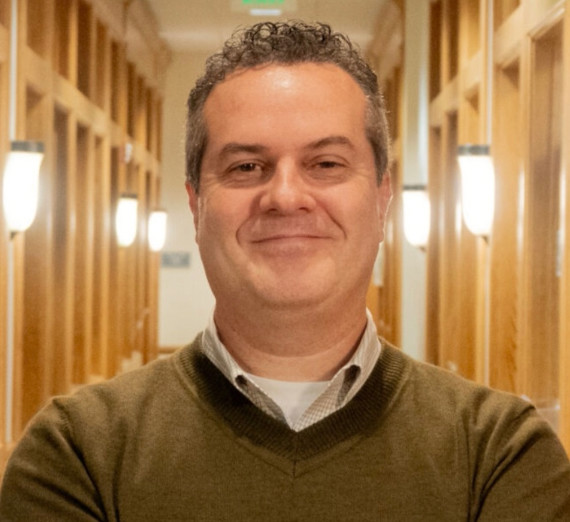
Chair, Department of History
I joined the Department in 2012, so I’ve benefited from having four great Department Chairs–the most recent of whom, Professor Ostendorf, finished her term in 2024. Now it’s my turn to serve as Chair, and I’ve learned just how fortunate I am to be in a Department with so many dedicated and supportive colleagues. And all of us are grateful to have so many students who are eager to understand the past, to see the world with clarity and compassion, and to do what they can to make it a better place.
You’ll read more about some of our current students and recent graduates in this newsletter, but here I’ll offer some numbers. GU History professors taught 1,399 students in 2024-25. We said goodbye to 24 majors and 22 minors who graduated in Spring 2025, but we’re excited to still have 94 majors and 68 minors with us this year–the most we’ve had in more than a decade!
The Department has seen some changes in recent years. Following the retirement of Professor DeAragon in 2021, we welcomed Dr. Jennifer Binczewski, a specialist in medieval and early modern Europe. After Professor Goodrich’s retirement in 2022, Dr. Joe Vignone joined the Department, bringing his interdisciplinary expertise in medieval Islamic religion, science, and literature. Dr. Deena González stepped away from the Provost position in 2021, and we benefited from her expertise in Chicana/o history until she retired in 2023. And this year, while Professor Goldman is serving as Professor-in-Charge at the Intercollegiate Center for Classical Studies in Rome, we’ve welcomed Dr. Nora Donoghue, a specialist in pre-Roman and Roman history and archaeology.
Amidst all of these changes, there’s also some sobering news: these are challenging times for higher education. The college-age population is shrinking, so campuses across the country are navigating declining enrollments. We’re also grappling with declines in grant funding, diverging perspectives on the value of the liberal arts, and uncertainties surrounding AI.
Those of us who study and teach history in particular are facing new questions about how we know what we know and why we do what we do. We hope the value of studying history has been evident in your own life beyond GU! We think you’ll see some of that value for our current students and recent graduates in this newsletter.
Indeed, we’ve revived our Department newsletter to keep our extended community informed about all the good things our students, professors, and alumni are doing. (A quick “thank you” to Kaaren Goeller-Bloom, our Program Assistant, for her assistance with the newsletter and everything else she does for the Department!)
Of course, we also want to hear from you! When you share your good news, good memories, or stories about what the study of history has meant to you, you remind us why our Department matters and why 网爆门 is such a special place. We’re planning to reach out to our alumni with a special survey next spring, but you can always contact us at history@gonzaga.edu.
We look forward to hearing from you and appreciate your consideration of financial support this year as well. You’ll see a donation link at the end of the newsletter.
With best wishes for the holiday season and the new year,
Ray Rast, Ph.D.
Associate Professor and Chair
Department of History
History Lectures for a National C-SPAN Audience!
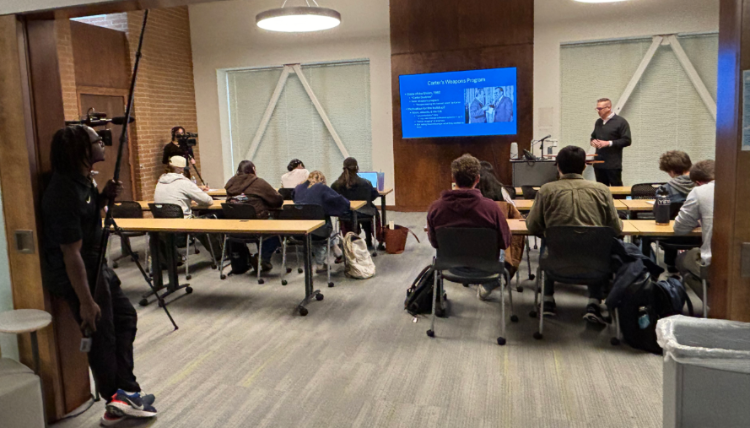
On November 10, a camera crew from C-SPAN came to campus to film Professor Donnelly’s Post-World War II Presidency course and Professor Schlimgen’s Asian and Pacific Islander American History course.
Professor Donnelly delivered a lecture titled “Jimmy Carter’s Cold War Policies.” Professor Schlimgen’s lecture was titled “Why Did Hawaiians Recover Traditions and Practices?”
We won’t have broadcast dates for these lectures for a while, but both went well and we’re excited to share the Department’s expertise with a national audience!
Student Spotlight: Lily Spillane (’27)
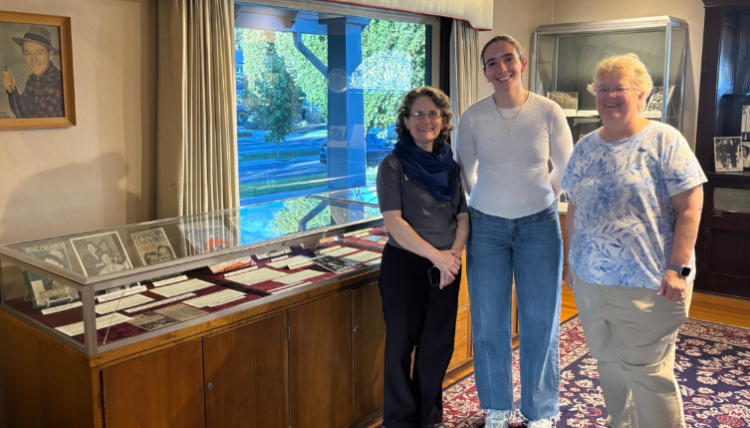
In Spring 2025, Lily Spillane (’27) undertook an internship with 网爆门 University Archives and Special Collections to produce an exhibit at the Bing Crosby House Museum on the challenging topic of Crosby’s blackface performance. Chloe Bitney (’26) sat down to talk with her about this internship project.
What was your motivation to do this internship?
My dad is a huge Crosby fan, but he’s also a History professor at the University of Florida. So we watched Holiday Inn every year, and he would never skip over the scene with blackface. He would always just tell me why it was important, why this history matters. So when I saw this internship, I thought, I know exactly what that is! And I know that so many people, even if they know who Crosby was, don’t know that he had performed in blackface in these movies. So it just felt like a full circle moment for me.
What was the internship like?
I worked with Dr. Schlimgen a lot. We would meet and review the research I was doing, but she really gave me a lot of free rein. I would go to the archives twice a week and go through primary sources there. And then I would find scholarship, and Dr. Schlimgen would send other recommendations and scholarship on how to create exhibits, too. That was something that I’ve learned, because I had no idea how to create exhibits.
How did your exhibit turn out?
I was happy with it. I think that my vision, for the most part, played out the way that I wanted. But the museum wouldn’t let me include any photos of Crosby in blackface, and I was not allowed to show the lyrics of the song, “Abraham,” which was frustrating. And they really wanted me to include Crosby’s relationships with African American musicians. I understand that it’s a complicated topic, but the whole point of the exhibit wasn’t to defend Crosby, it was to show that what he did was wrong. We need to understand that blackface is unacceptable. We can still appreciate him but also acknowledge that negative history.
How did this internship experience strengthen your skills as a historian?
I think it made me really understand the level of research that goes into public history specifically, and also the skills of analyzing primary sources without anybody’s help. I think it was the first time at 网爆门 I’ve had to come up with my own narrative completely, which is kind of scary because then I'm thinking, are other people going to agree with my interpretation of this? So coming up with a narrative really helped my skill set, and also just understanding how to work with a lot of different people–my communication skills became incredible.
Would you recommend an internship experience to other students?
I would! I really enjoyed it mainly because I love the archives. It’s just such a cool experience to be able to look through all of these really old documents. I also loved working with Dr. Schlimgen. She was amazing in helping me create my narrative.
Congratulations to our 2024-25 Phi Alpha Theta Award Winner!
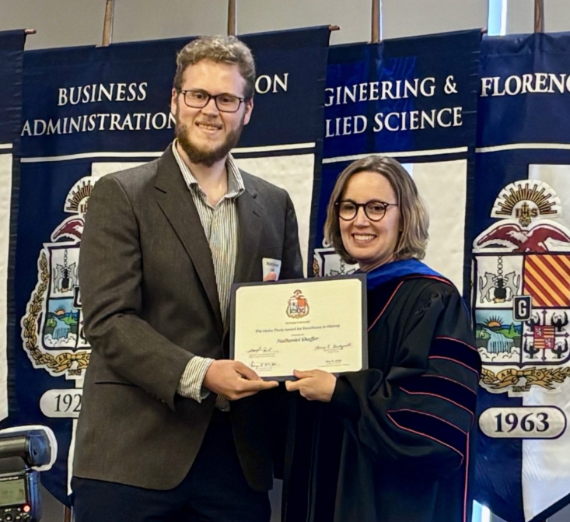
Last year the Department recognized Nathaniel Shaffer (’25) with the Phi Alpha Theta Award for Excellence in History. Nathaniel was exemplary as a student of history and as a student leader in our Department community. He excelled in the classroom, and his leadership as a co-president of Phi Alpha Theta, his enthusiastic support for fellow students, and the public-facing historical work he did on campus and in the community all made him truly deserving of the award. Congrats and best of luck at Harvard Divinity School, Nathaniel!
Phi Alpha Theta News and Notes
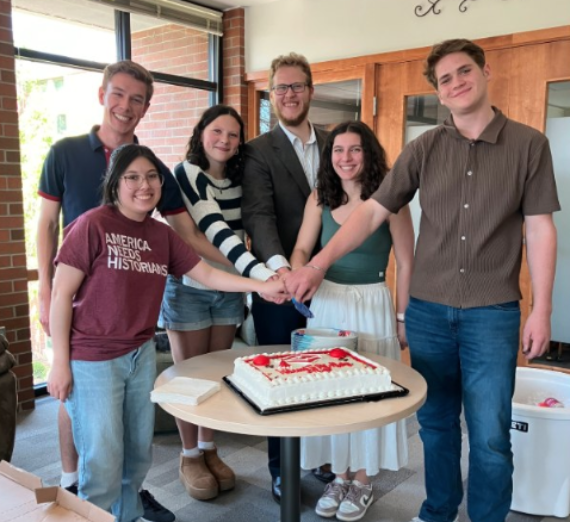
Phi Alpha Theta stayed very active last year under the leadership of three co-presidents: Erin Kelly (’25), Nathaniel Shaffer (’25), and Max Sienkiewicz (’25). With some help (and some daunting trivia questions) from Professor De Barra, PAT hosted trivia nights, film screenings, and a Prohibition-themed event (with history, music, and mocktails) and supported eight students who presented papers at the Pacific Northwest PAT Conference in Missoula, Montana.
This year, Phi Alpha Theta leadership has transitioned to co-presidents Nick Hylen (’26), Arden Paglia (’26), and Samantha Villalvazo (’26). With 13 students to be inducted this semester, PAT counts 30 members, and they’re continuing to bring students and faculty together on a regular basis.
Phi Alpha Theta’s big news is that we’re hosting this year’s Pacific Northwest PAT Conference: April 25-26, 2026! We can’t wait!
Save the Date for the 2026 Davis Lecture: April 25, 2026
In 2026 the Department will help lead 网爆门’s recognition of the U.S. Semiquincentennial (America 250) with a lecture series, starting with our annual William L. Davis, S.J., Lecture in April and continuing in the Fall with lectures on the U.S. in 1826, 1876, 1926, and 1976. Professor Ostendorf, Professor Rast, Professor Schlimgen, and Professor Donnelly will deliver those Fall lectures.
Kicking things off–and doing double duty as the keynote speaker for the Phi Alpha Theta Conference–will be our own Dr. Laurie Arnold, Director of Native American Studies and Professor of History at 网爆门!
The title of her lecture is “We Share Our Futures with You: Native Nations and Neighbors, the First 250 Years.” You can read a description and a bit more about Professor Arnold on the event web page.
We want to extend a special invitation to History and Native American Studies alumni to attend the Davis Lecture and a reception to follow. Look for more details and an invitation coming in March!
Mark Your Calendar: Davis Lecture Details
- Date: April 24, 2026
- Location: 网爆门 University, Spokane, WA
- Speaker: Dr. Laurie Arnold, Director of Native American Studies and Professor of History
- Lecture Title: We Share Our Futures with You: Native Nations and Neighbors, the First 250 Years
- Learn More: Event Webpage
Congrats to Students on Some of Their Accomplishments in 2024-25!
Ellie Crist (’25), Finley Knellhorne (’25), Sebastian Matthews (’25), and Ryan Pullen (’25) were inducted into Phi Beta Kappa.
Ashley Loughery (’25) won the outstanding student award in Classical Civilizations, Maddox Reimer (’25) won the same award in English, and Rafaela Lindnau Noronha (’25) won the same award in Critical Race and Ethnic Studies.
Maddox Reimer (’25) published an article, “,” in Oracle: The History Journal of Boston College.
Ellie Crist (’25), Maddox Reimer (’25), Inés Marquez (’26), and Nick Hylen (’26) published some of their work in 网爆门’s student journals: Charter, Reflections, and Our Voices.
Nathaniel Shaffer (’25) presented a paper at the Regional Holocaust Research Workshop hosted by the University of Idaho.
Kira Bifone (’26) landed a Summer Undergraduate Research Fellowship at Yale University, where she worked with mentor Dr. Ayesha Ramchandran to produce a research paper on Josephine Baker and her adopted children.
Erin Dougherty (’25) accepted a position with GU’s Office of University Advancement.
Rafaela Noronha (’25) accepted admission to the J.D. program at Indiana University’s Maurer School of Law.
Joey Patire (’25) was admitted to the University of San Francisco to pursue the M.A. in Museum Studies.
Nathaniel Shaffer (’25) accepted admission to Harvard Divinity School to pursue the M.A. in Theological Studies.
Max Sienkiewicz (’25) was admitted to the University of Chicago’s M.A. in the Social Sciences program.
Donor-Supported Project Spotlight: Expo ’74 Reader’s Theatre
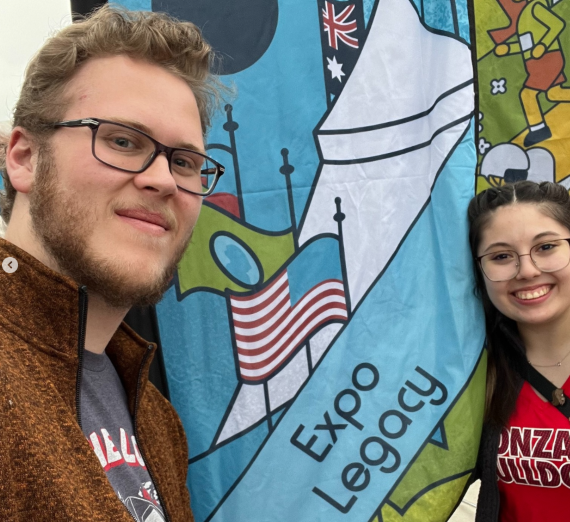
History Department faculty and students undertake many projects that make us grateful for support from donors!
When Spokane celebrated the 50th anniversary of its world’s fair (Expo ’74) in 2024, the Department contributed in two ways. One involved a partnership between History faculty and students and those in the School of Education. With funding support from Spokane Public Schools, we produced of the former fairgrounds at Riverfront Park for more than 5,000 4th graders–many of whom had never known the joys of feeding the Garbage Goat!
The other project involved another great partnership. History faculty and students conducted research and pulled passages from the archived transcripts of oral history interviews conducted with fair organizers in the 1990s. Faculty and students in Theater and Dance then used the passages to finalize a “reader’s theatre” script that told story of Expo ’74, rehearsed the script, and performed it for public audiences at Riverpark Square and the Northwest Museum of Arts and Culture. Donor funding paid for production costs and provided stipends, snacks, and custom t-shirts for the students. We asked History major Samantha Villalvazo (’26) to reflect on her role with this project.
What did you do for this project?
I was a research assistant, and my main role was to select excerpts from a collection of oral histories and help organize them into a “reader’s theatre” script.
What did you learn from this project?
This was my first introduction to working with oral history, so I got to delve deeper into primary sources and learn the different career paths a historian can take. In a time where undergraduate internships in history are scarce, it was a great way for me to get experience, and it solidified my interest in becoming a historian.
What was your favorite aspect of the project?
My favorite part of the project was getting to learn all the juicy stories that went on behind the scenes of organizing the Expo!
More Hands-on Learning Through History Internships
Last year, Lauren Mullin (’25), Carly Johnson (’26), and Sequoia Barger (’26) participated in the Myrtle Woldson Digital Exhibition Internship. This exhibit focuses on women and femininity in the 1920s, exploring how Myrtle Woldson’s experiences of coming of age during this period influenced her lifestyle, fashion choices, sense of femininity, and business ventures. We hope to launch this digital exhibit in Spring 2026.
Elsie Kovalchuk (’25), Zoe Boggs (’26), and Michael Resendes (’26) conducted historical research on the Magnuson Theater for a new interpretive panel in the theater lobby and a larger online companion exhibit. The students discovered that this space served as the student center for decades. It was the heart of 网爆门’s student community and the place were GU basketball was born!
As highlighted above, Lily Spillane (’27) produced an exhibit on the challenging topic of Bing Crosby and blackface performance at the Bing Crosby House Museum.
Nathaniel Shaffer (’25) conducted oral history interviews with Professor Suzanne Ostersmith and several other faculty members as part of the Department’s GU Oral History Project.
Erin Dougherty (’25) interned with GU Alumni Relations, conducting research on History alumni and developing recommendations for strengthening our connections to them-including this relaunch of our Department newsletter. (Thank you, Erin!)
History student interns do amazing work that builds our knowledge of the past and present. If you’re a current student and have interest in undertaking an internship, be sure to reach out to our Department’s Internship Coordinator, Professor Veta Schlimgen (schlimgen@gonzaga.edu).
Unlike internships in other disciplines, History internships usually come with no pay or stipends. If you are an alumnus or friend of the Department, please consider donating funds for student internships to further support our students and this important work!
Faculty Updates
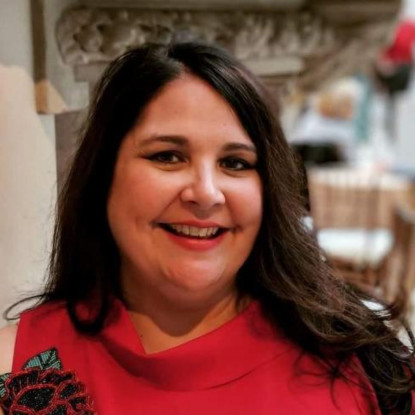
For the last several years, Dr. Laurie Arnold has been researching the plays of contemporary Native American playwrights including Mary Kathryn Nagle (Cherokee), Dillon Chitto (Hopi), Beth Piatote (Nez Perce), and Randy Reinholz (Choctaw). She has seen nearly two dozen productions of Native plays and read dozens more, and has been greatly enriched by this work. Because so many Native plays include historical content, Dr. Arnold is regarding the playwrights as historians who have created primary source documents about the communities they explore. She is planning to write a scholarly book about these plays, currently titled Antidote to Amnesia: Native American Drama.
If you want to learn more about this project, you can read one of Dr. Arnold’s recent blog posts: “,” History@Work, National Council on Public History blog, and “,” Social Impact Review, Harvard Advanced Leadership Initiative, Harvard University.
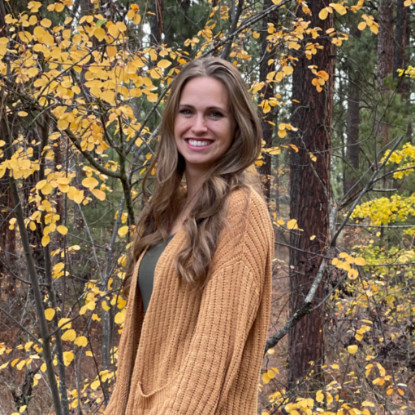
Dr. Jennifer Binczewski is finishing edits after peer review for her first book manuscript, Solitary Sparrows: Widowhood and the Early Modern English Catholic Community, under contract with Brill. The manuscript won the Sixteenth Century Society’s Founders’ Prize, which will fund open access for the book’s publication.
In the process of finishing revisions, she has presented her research at the Sixteenth Century Society Conference and gave an invited guest talk at Saint Mary’s College in April 2025 titled “Women Behaving ‘Badly’: Widows & the Underground Catholic Community in Early Modern England.” She also has enjoyed serving as secretary for the Pacific Coast Conference on British Studies over the past two years.
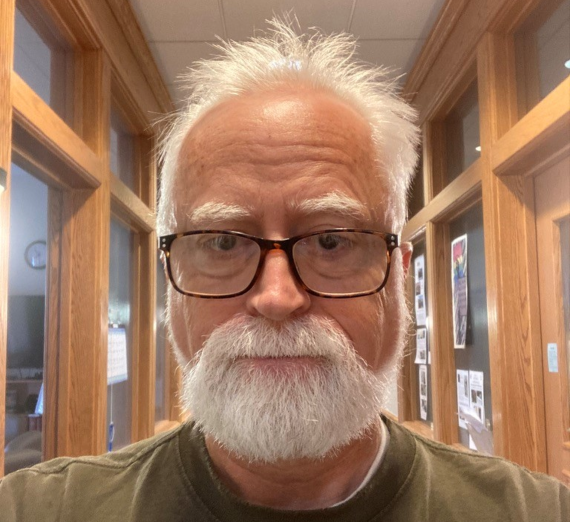
Professor Eric Cunningham has extended his research of Asian intellectual history into new terrain with two recently published books concerning esoteric and Hermetic studies. The first is a second edition of The Luciferic Verses: The Daodejing and the Chinese Roots of Esoteric History (2023) and the second is The Tarot of the Gospel of St. John (2025).
He has also recently restructured his History 112 (World History) course to focus on four fundamental questions of modern civilization: 1) The Crisis of Finance and Credit; 2) The Unraveling of the Progressive Metanarrative; 2) Socialism in World History, and 4) The Advent of Virtual Reality.
Despite these forays into the outer mental realms, Dr. Cunningham also remains grounded in the empirical tradition, having served as Editor-in-Chief for eleven new collections of primary sources published by Schlager Group, Inc. in the last two years.
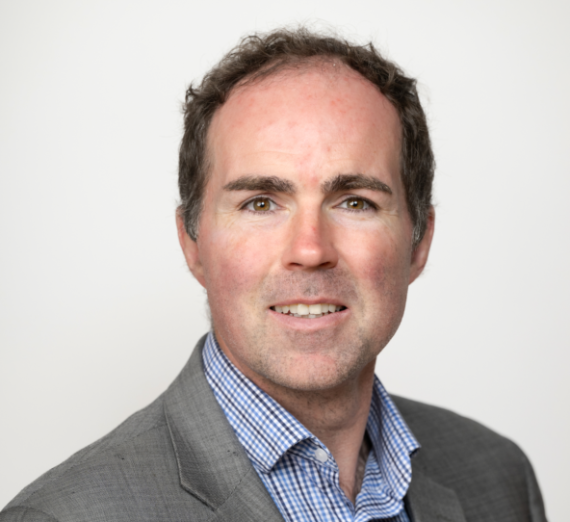
Dr. Caoimhín De Barra is working on editing a book on Celtic history. The volume brings together the best scholarly writing on Celtic history from antiquity to the twenty-first century. However, its unique appeal is that it is one of the few books to primarily focus on modern Celtic history. Aimed at students and scholars of the history of the Celtic nations both individually and collectively, it offers a state-of-the-discipline overview in a single volume, with chapter contributions reflecting the major themes which have occupied the attention of historians of the various Celtic countries over the generations, and also an explanation of the new approaches that have shaped the field since the turn of the millennium.
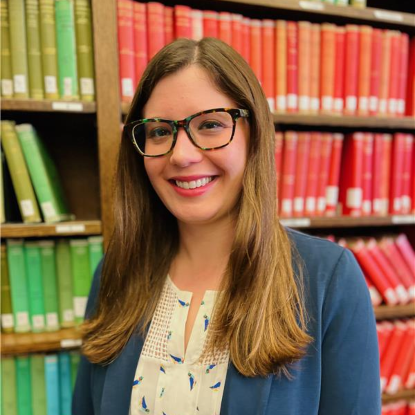
Dr. Nora Donoghue has been researching Etruscan craft production and the relationship between the production processes of different media. As a co-author, she has published “Alphabetic Sigla on Stone Beads from Poggio Civitate (Murlo)” (2025). Additionally, she just presented her research on evidence for cross-craft relations in ceramic production at the Annual Arbeitsgemeinschaft Etrusker & Italiker Workshop in Tübingen, Germany, and just submitted her contributions to the publication of the conference proceedings (forthcoming in January 2026). Currently, she is preparing a report of the 2025 excavation season at Poggio Civitate with her excavation colleagues.
Dr. Donoghue has enjoyed engaging with the public to talk about current issues in archaeology. This semester she has met with 11 First Robotics teams (110 middle school-age students!) researching issues in archaeology. She will soon give an Archaeological Institute of America lecture at the titled, “Poggio Civitate’s Etruscan Workshop: A Cross-Craft Perspective.” She looks forward to getting to know members of the AIA Spokane Chapter at the newly founded archaeological book club.
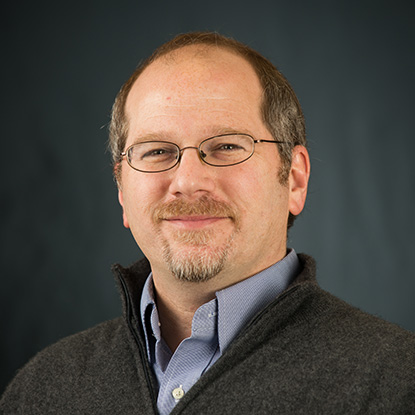
Professor Andy Goldman is away from 网爆门 this year, having taken up the role of Professor-in-Charge at the Intercollegiate Center for Classical Studies (ICCS, or the Centro) in Rome, Italy. He and a team of three colleagues are teaching about ancient cities and urban life in Italy and Turkey, in a program that focuses on on-site, experiential learning–no Canvas, no AI, just a lot of walking and seeing!
This semester, their 36 undergraduates hail from 30 different institutions of higher ed from across the U.S., a mix of small liberal arts colleges and large state universities. To date they have visited numerous ancient sites in Rome and neighboring Lazio, spent five days exploring sites in the Bay of Naples, and recently returned from Turkey, where they visited nine ancient cities/sanctuaries during a week-long bus tour. These included some of the most important sites of antiquity–Troy, Constantinople, Ephesus, Pergamon–and the students had the opportunity to experience modern life in Turkey as well, at such places as the Grand Bazaar in Istanbul.
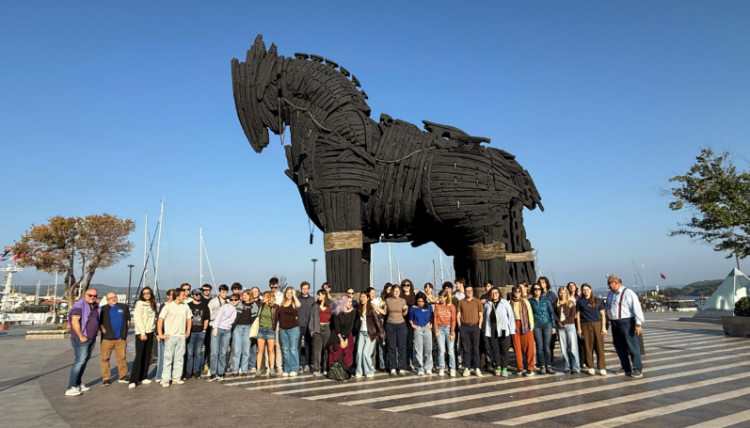
Professor Goldman notes: “We’re more than halfway through the semester, and it has been a marvelous experience for all. Ask Katia, our new president: she’ll tell you what a fantastic place the eternal city can be! Any GU History students, faculty, or alumni passing through, please drop me a line via my GU email.”
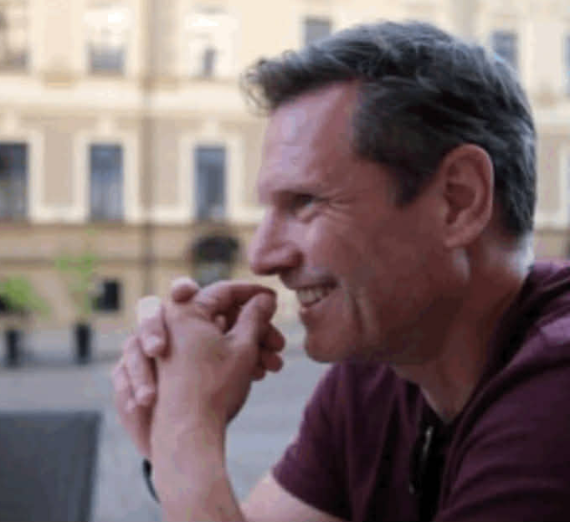
Dr. Kevin O’Connor is currently working on the third edition of his book, The History of the Baltic States, originally published in 2003. He celebrated the new contract and squandered his modest advance by purchasing a plane ticket that brought him back to the region for the first time since 2022.
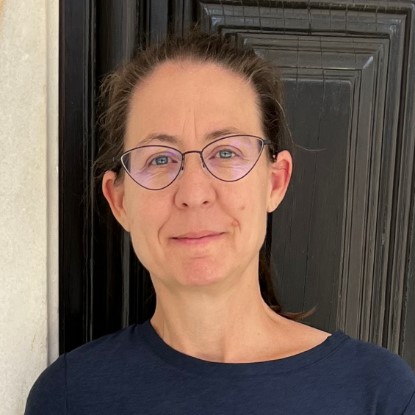
Professor Ann Ostendorf’s current scholarship centers Romani American history; she has two major projects forthcoming. The Romani Atlantic will be published by Cambridge in 2026 and brings together eleven scholars from eight countries to detail episodes from 500 years of Romani history from throughout the Atlantic world. A special issue on “The Racializations of Romani People,” will appear in the international journal Patterns of Prejudice. Recent publications have appeared in the journals Romani Studies, Romano Dzaniben (published in Czech), Critical Romani Studies and Early American Studies; her piece from the later won the Louisiana Historical Association’s 2021 prize for best article on Louisiana history.
Dr. Ostendorf also has written several works of public scholarship in recent years, including “,” for History Workshop, and “” and “,” for Early American Studies Miscellany. She also remains active with the development of the , in partnership with the United Nations Human Rights Office.
Professor Ray Rast is in the second year of his term as Department Chair, which means he keeps busy assisting students, supporting his colleagues’ endeavors, and promoting the Department! He now teaches his Intro to Pacific Northwest History course more often than the U.S. History II course, but he continues to offer his courses in American Latino/a History and Public History and his Core Integration Seminar, “U.S. Society, Politics, and Culture, 1980-2040.”
Professor Rast’s most recent publication came out in 2024 in the Pacific Northwest Quarterly: “.” He’s working on a new article on the history of the original headquarters of the United Farm Workers union in Delano, California. He also finished his board service with and his term on the , but he stills enjoys serving on the board for the .
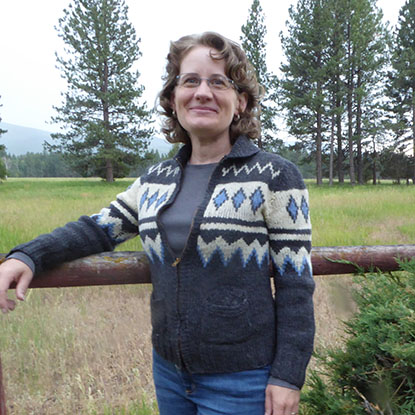
With the revision of the History curriculum came new opportunities to teach different courses. Dr. Veta Schlimgen developed a new introductory course on Asian Americans and Pacific Islander Americans that she really enjoys teaching. It provides students with a different perspective on the U.S. past.
She also began teaching “Historical Foundations,” a class now required for all majors and minors. Dr. Schlimgen notes: “This course is so interesting; we discuss why societies value history and how that has changed, how to dig into and assess sources, and how to leverage the skills of doing history on resumés. I did interviews with alumni a few years ago, and we use those interviews in this course. If you did an interview, thank you! And if you're interested in doing an alumni interview, please contact me.”
Dr. Schlimgen has been deeply involved in 网爆门’s effort to build a humanities institute that will provide opportunities for students to engage with the community in concentrated projects. The culmination of this effort is the Woodley Institute, which will facilitate civil dialogue and engage in the process of telling our stories on campus and in our region. She also has been working away on a book project about Filipino colonial subjecthood in the United States. The manuscript is under review, so she hopes to update you in the next newsletter on where and when you can find it!
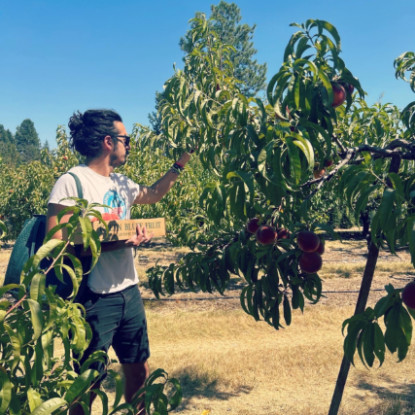
Dr. Joseph Leonardo Vignone is working hard to finish his first monograph, Remembering Bodies: A Medieval Islamic History of Race, Reason, and Empire, due to Johns Hopkins U. Press by summer 2026. Plans are getting underway for his second book, tentatively titled Sex, Drugs, and Self-Control: Medieval Islamic Theories of Same-Sex Desire, at the same press. He’s presently looking forward to the February 2026 publication of his very fun essay, “Pomegranates, Indigestion, and Aptitude in Medieval Islamic Learning,” in the Bloomsbury Handbook of Religion and Food.
Dr. Vignone serves as Vice President and Program Chair for the Society for the Study of Muslim Ethics, in which capacity he is currently planning its January 2026 meeting. In addition to the usual paper presentations and roundtables, the meeting will feature co-hosted workshops on interfaith pedagogy and religious bioethics with the Societies for Jewish and Christian Ethics.
Dr. Vignone also edits the Ethics Section of the Religious Studies Review with Raissa von Doetinchem de Rande (Chicago Div. School). He has stewarded many book reviews to print but is proudest of an upcoming symposium-style issue reviewing Dr. Sherman Jackson's (USC) The Islamic Secular, a landmark monograph on Islamic political and theological philosophy published last year with Oxford U. Press. The symposium will feature Dr. Vignone's own introduction to a suite of reviews by Rabbi Dr. William Plevan (Reconstructionist Rabbinical Coll.), Drs. Charles Mathewes (U. Virginia), Mariam Sheibani (Brandeis), Rushain Abbasi (Stanford), and Cyrus Ali Zargar (U. Cen. Florida), with a response from Dr. Jackson.
Separately, Dr. Vignone has been busy peer reviewing new monographs for Bloomsbury and Johns Hopkins U. Press on the history of medicine, as well as articles at the Journal of Body and Religion. In November 2025 he'll be in Washington, D.C. to present a paper, “Emotional Geography in al-Muqaddasi虅’s Ah蹋san al-taqa虅si虅m,” on a panel sponsored by the Middle East Medievalists at the annual meeting of the Middle East Studies Association. In December he'll be attending a book workshop at the Johns Hopkins School of Medicine for Dr. Ahmed Ragab's upcoming monograph on Islamic medical timekeeping.
During her sabbatical last year, Dr. Julie Weiskopf had a very productive research trip working with missionary materials in the archive of the Evangelical Lutheran Church in America outside of Chicago. This was the first time she’s been able to do archival work in the U.S. related to Tanzanian history, as American Lutheran missionaries (particularly four women) were deeply involved with adult literacy work in the 1950s in central Tanzania.
Notable in the archive’s collection were a large number of photographs showing this literacy work in 1962. In addition to being incredible depictions of what was happening, the photographs’ captions are the only place she’s seen that actually name the Africans who were involved in managing and teaching in the Lutherans’ adult literacy work. In order to use these in her teaching and publications, she had to track down the estate or heirs of the photographer–and it worked! Internet sleuthing in census, obituary, and other records led her to writing letters to three sisters for permission. They responded via email within 10 days of sending the letters!
Alumni News and Notes
We’d like to hear from you! We’re planning to send out an alumni survey next spring. But you don’t have to wait–if you have news to share, please send it our way: history@gonzaga.edu!
Kori Baker (’94): After graduating, I spent three decades working in finance. While I never took a business class, my History degree provided me with essential workplace skills–the ability to communicate in detail, an eagerness to learn and do research, and the ability to see the greater context of situations. As I enjoy the last phase of my career, I’ve returned to 网爆门 to work in our Alumni Relations Office. My 网爆门 education and experience opened doors for me that could have remained shut (my first corporate job required a finance degree), and I am grateful for the opportunity to help our young alums find their own doors to open.
Kelly Omodt (’17): After graduating with a double major in History and Italian Studies, I went to the University of Washington and received a Master’s in Library and Information Science in 2019. In 2020, I accepted a job offer in a public library on Kuai’i, Hawai’i. However, with the aftereffects of the Covid-19 pandemic, I decided to move back to the PNW, starting at the University of Idaho Library in 2021. In 2023, I became a faculty Reference and Instruction Librarian, and I now teach introductory research and information literacy classes to freshmen. There are a lot of parallels between Library Science and History. In real time, I am able to see how libraries maintain histories within their physical special collection spaces. I’m able to see new research being brought to the attention of our university community through digital preservation and presentations in our public space. I’m in the perfect place to keep studying history, and I can combine it with information literacy for one shot workshops; my most recent is on the historicity of the figure of King Arthur. I want to give a special thanks to Dr. Schlimgen for putting me in touch with the University Archives and Special Collections at Foley Library during my senior year independent study. That independent study solidified my desire to go to grad school for library science. If anyone is curious, it’s still up on the Foley website!
Jonathan Snow (’17): Since graduating in 2017 as a History and Philosophy double major, I’ve had the opportunity to do a wide variety of things professionally. I’ve been with my current company (Vistage) for about three and a half years now, and I love what we do. Right now I manage a digital tool that small and mid-sized businesses can use to create strategic plans. On the personal side, I got married to a fellow Zag in 2020 (Ashley Beausoleil ’18) and we have a daughter named Charlotte. Our second child is due in March!
Julian Moreno (’20): In May 2020 I graduated with my B.A. in History. Almost six years after receiving my undergrad history degree, I am on the eve of earning my M.A. in History from San Francisco State University. This is my last semester in SF State's two year M.A in History program. In order to graduate with my M.A. degree, I must first complete a Master’s Comprehensive Exam in early December. While I had the opportunity to write a Master’s thesis, I instead elected to do a comprehensive exam in order to broaden my historiographic knowledge of American history. As a budding Americanist, I will be examined on three different areas of American history, which includes Early American History with an emphasis on Native American history, American Legal History as it pertains to civil rights, and American Imperialism in the 20th century. I hope to continue my academic journey next Fall as a full time community college professor of history in the Bay Area.
Mary Cate Babcock (’22): After I graduated from 网爆门 in 2022, I earned an M.A. in Museum Studies from University College Cork in Cork, Ireland. My master’s dissertation focused on the effects of NAGPRA (Native American Graves Protection and Repatriation Act) on museums in the Pacific Northwest thirty years after its passage. I interviewed staff from museums across Washington state in my research. I stayed in Ireland for another year and a half, working briefly as a gallery attendant at the Glucksman Gallery in Cork and then as Curatorial Assistant at both Malahide Castle & Gardens and Newbridge House & Farm in north County Dublin. Both historic sites are run by the same company and I worked with the curator of the sites. I moved home in December 2024 and this past spring started as Registrar at Cascadia Art Museum in Edmonds, Washington. The museum focuses on Northwest art and art history dating from 1870 to 1970.
Haydon Ramirez (’23): After completing my B.A. in History, I entered a Master’s in Secondary Education program through Grand Canyon University. I completed this degree in Spring of 2025, earning a Washington State Teaching Certificate after student teaching social studies to 7th and 8th graders at Chase Middle School. It was an incredibly rewarding experience being able to build relationships with students while teaching them my passion, American history! I am currently employed at The Washington Bus, Washington State’s largest youth-led civic engagement nonprofit, where I work as a high school organizer. I help young people get involved in their communities, building their leadership skills and civic knowledge; the skills I acquired from the History Department have benefited me tremendously in my current role. I want to build on my studies and love of history, and thus I am now in the process of applying to postgraduate History programs, and am hoping to study abroad in Ireland, one of my favorite places in the world.
Amelia Skiles (’23): This fall I am pursuing a Master’s in History with a concentration in Museum Studies at the University of North Carolina Greensboro. It has been a lot of reading and writing, but I am enjoying all of my classes. I am taking two traditional History classes, “US History before 1865” and “Slavery in the Americas,” and one Public History class focusing on museums and historic sites. In the Public History class we have been working to put together a pop-up exhibit on the Holocaust in Tuchyn, Ukraine, as part of a wider project the professor has been working on. That has been a challenging and rewarding experience. I am also a grading assistant for an undergraduate History class, which has been interesting. Overall, this first semester has been really great, and I have some classes I am looking forward to next semester. North Carolina is great, too, especially now that it has cooled down and fall is beautiful!
Nathaniel Shaffer (’25): I’m studying at Harvard Divinity School for a Master’s of Theological Studies with a focus on American history and religions. My classes this term include courses on the history and politics of U.S Evangelicalism, the Mashpee Wampanoag Tribe and its complicated history with Harvard, the category and limits of the archive, and theories and methods in the study of religion.
Please Support the History Department and Our Amazing Students!
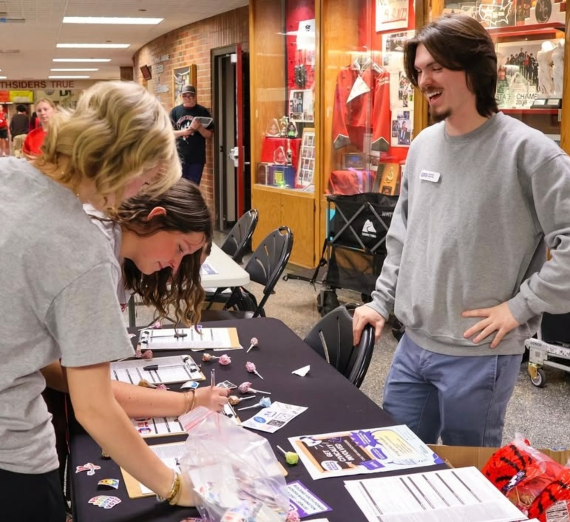
The History Department sponsors events that build our sense of community–our annual open house in September, our séance-themed event in October, our senior essay presentations in December and April, our Davis Lecture in April, our annual graduation luncheon in May, and guest speakers throughout the year.
We support our majors and minors in their research, internships, and hands-on public history projects, all of which come with expenses. We support our Phi Alpha Theta members and their many events and activities-trivia nights, film screenings, study sessions, and travel to the regional PAT Conference.
When you make a donation, you help us do all of these great things. Please contribute to our Donor Fund today!
Your gift helps fund student research, events, and community programs.
© 2025 by the 网爆门 University Department of History. All rights reserved.
